
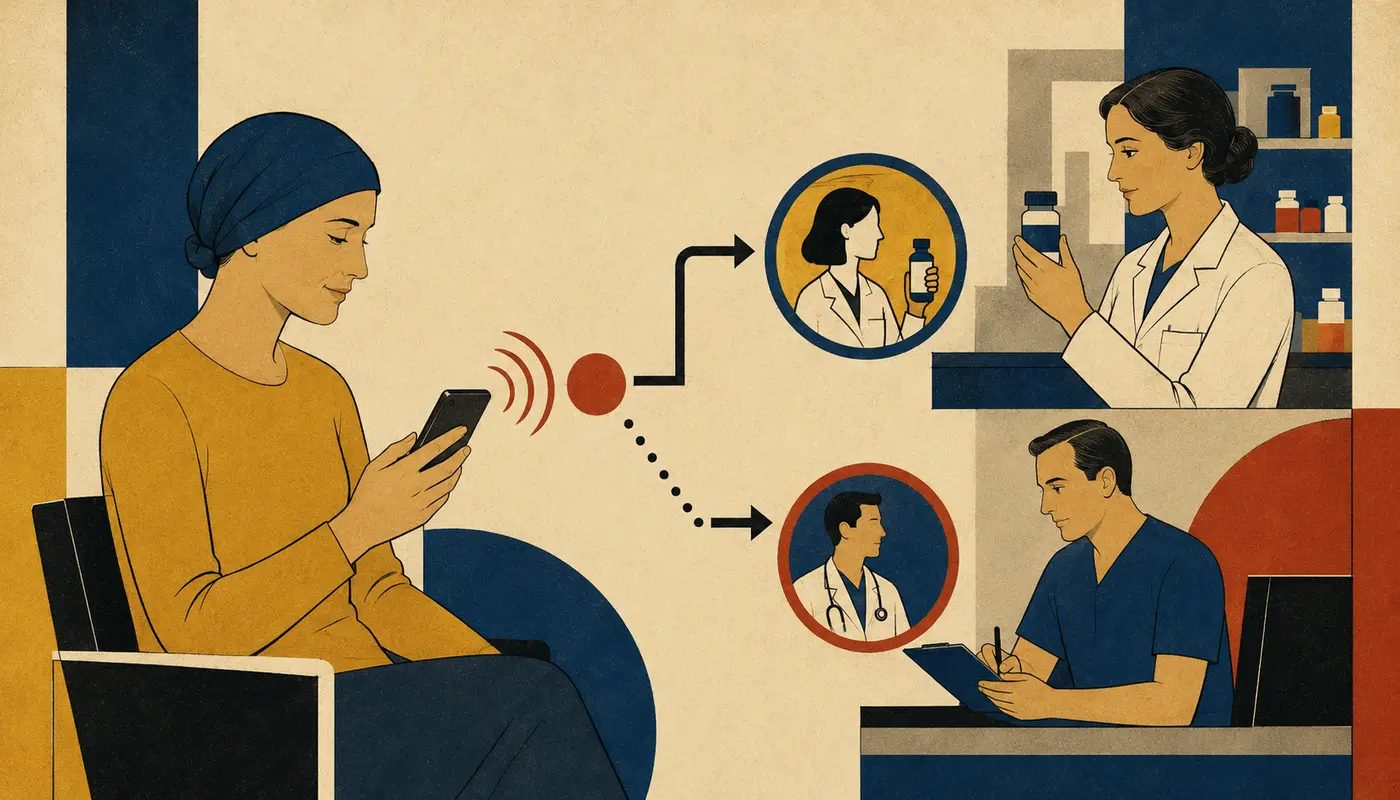
Digital patient questionnaires do not improve care simply by collecting data. Their benefit arises when a relevant change is detected, prioritised and handled personally within a defined time. The German Innovation Fund project PRO B demonstrates this principle in the support of women with metastatic breast cancer.
From questionnaire to care pathway
Patients regularly reported symptoms, everyday functioning and emotional burden through an app. An algorithm evaluated the responses and alerted the treatment team to relevant deterioration. The signal was therefore not just information; it triggered a defined clinical process.
The Innovation Committee at the German Federal Joint Committee documents the project, results and transfer recommendation. The intervention was designed to identify deterioration caused by treatment effects or disease progression earlier and reduce unplanned hospital contacts.
The critical component is the response organisation
A digital alert without clear ownership can create false reassurance. Every implementation needs rules for thresholds, response times, deputies, documentation and escalation. It must also define which signal can be handled through counselling, when the treatment team must decide and when emergency care is required.
Consent, data protection and access rights must match the actual care pathway. Permission to view a record does not automatically confer medical decision authority. Roles and responsibilities therefore belong in the QMS and in contracts with service providers.
How pharmacies can contribute
Many cancer therapies are used at home, making pharmacies an accessible contact for nausea, fatigue, pain, adherence, interactions and supportive medication. A digital pathway can strengthen that role but must not create competing escalation routes.
Useful interfaces include structured medicines counselling, adherence support, recognition of possible adverse effects and documented referral to the responsible clinical team. The pharmacy does not replace oncology decisions; it can stabilise care between appointments.
Five conditions for scalable delivery
- clinically validated questions and transparent thresholds,
- binding response times and deputy arrangements,
- a clear emergency and escalation pathway,
- data-protection-compliant roles, access and records,
- integration with existing hospital, practice and pharmacy workflows.
tiger.PHARMA position and services
tiger.PHARMA translates digital care concepts into operational workflows. For pharmacies we design counselling, documentation and escalation processes. With manufacturers, wholesalers and logistics providers we structure product data, patient-support interfaces, continuity of supply and the controlled handling of treatment-critical signals. QMS, data interfaces and role models are designed together.
The practical value lies in implementation: an app becomes a dependable care process with measurable deadlines, clear accountability and safe medicines support.