
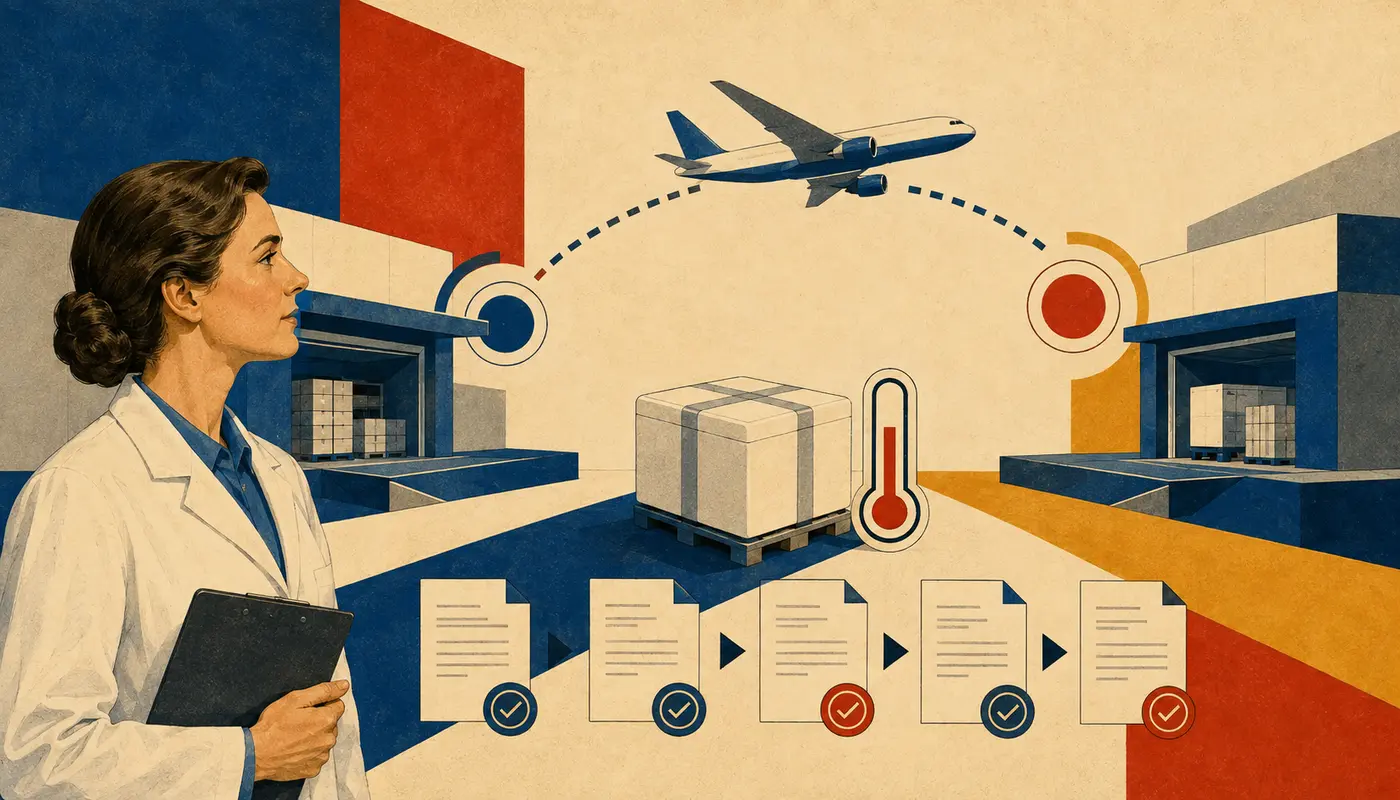
Additional air-cargo capacity between China, Southeast Asia, the Middle East and Europe can make pharmaceutical supply chains more flexible. For medicines, nominal tonnage is not decisive. Route, handling, temperature control, customs, transit time and contingency design must match the individual product profile and remain demonstrably controlled.
New capacity changes the available options
The DHL Group reports an expanded gateway in Shenzhen and a daily freighter connection via Shanghai, Bangkok, Bahrain and Brussels. The investment adds processing and flight capacity and includes life-sciences and healthcare shipments among the addressed sectors.
A new connection may shorten transit times or provide an additional backup. It is not automatically qualified for every medicine, temperature band or criticality. Cold-chain products, biologics, clinical-trial material and time-critical medicines require evaluation of the actual end-to-end process.
A lane is more than the flight
The risk path begins at the shipper and ends only after documented handover to the consignee. It includes pre-carriage, export clearance, security screening, storage, apron exposure, flight, transit hubs, import customs and last mile. Every transfer can introduce waiting time, temperature stress, misrouting or a data gap.
The EU Guidelines on Good Distribution Practice require storage conditions to be maintained during transport. Responsibility cannot be outsourced solely by appointing a recognised carrier.
Seven qualification questions
- Product profile: temperature range, stability, value, criticality and permitted transit time.
- Route map: all hubs, handovers, storage points and subcontractors.
- Temperature risk: seasonal extremes, apron time and active or passive packaging.
- Customs: cut-offs, permits, product descriptions and escalation.
- Data: tracking, logger access, timestamps, alarms and retention.
- Deviation: quarantine, quality decision, CAPA and communication deadlines.
- Continuity: alternative route, replacement hub and weekend or crisis process.
Capacity can also add complexity
A larger hub improves scale but increases the importance of controlled sorting and transfer. A new flight sequence may connect more markets while adding transit points. Performance should therefore be measured by product-class punctuality, temperature excursions, customs holds, damage, data completeness and response time, not average transit time alone.
tiger.PHARMA position and services
tiger.PHARMA qualifies pharmaceutical lanes from product profile to last mile. We support manufacturers, wholesalers and logistics providers with risk analysis, user requirements, transport and packaging concepts, service-provider audits, temperature mapping, service-level agreements and contingency routes. For pharmacies and e-pharmacies we integrate receipt, cold-chain evidence, deviation assessment and complaints into the QMS.
The result is a defensible decision basis: new capacity is used where it improves quality and supply, not merely where a flight is available.