
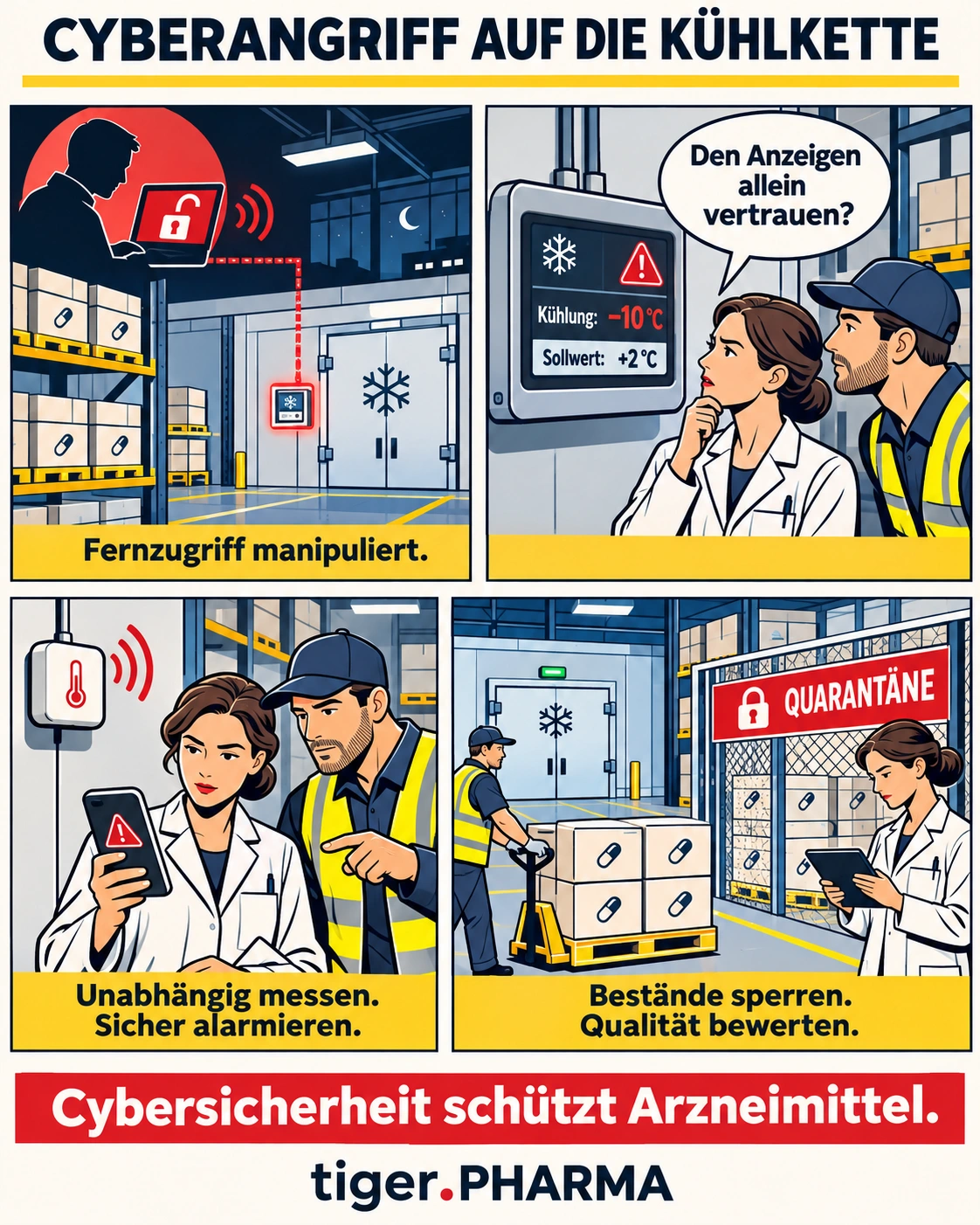
Cybersecurity in pharmaceutical logistics protects medicine quality and supply continuity. Digital interference with refrigeration controls, building systems or temperature monitoring can compromise storage conditions and the evidence needed to assess product quality. Pharmaceutical warehouses, wholesalers and logistics contractors should include this scenario in GDP risk management.
Cyberattacks on refrigeration: a pharmaceutical cold chain risk
Connected refrigeration enables remote maintenance and configuration. Unauthorised access can also alter setpoints, interrupt cooling or interfere with alarms, even when power and mechanical equipment remain available. Backup power alone cannot prevent manipulated settings.
Consequences may include quarantined stock, additional quality assessments, product losses and interrupted deliveries. Excessive cooling can also damage sensitive medicines. The risk extends to temperature-controlled ambient warehouses: the medicine's specific storage requirements determine the controls needed.
Connect GDP risk management with operational technology security
Refrigeration controllers are operational technology, or OT. Quality assurance, warehouse operations, engineering and IT need a coordinated approach. EU GDP addresses environmental conditions, alarm testing, protected computerised systems and system failure procedures. The technical safeguards below are risk-based implementation recommendations, rather than a verbatim list of additional GDP obligations.
Begin with an inventory of controllers, sensors, data platforms, remote connections, system owners and vendor support status. Identify shared dependencies. Two units do not provide sufficient independence if one administrative account can compromise both.
Secure remote access to refrigeration systems
- Keep management interfaces off the public internet and segment operational technology appropriately from office IT.
- Use controlled encrypted access, individual accounts, limited permissions and multi-factor authentication at the access gateway.
- Record contractor connections, enable access when needed and close it afterwards. Retain traceable records of changes to setpoints, alarm limits and configurations.
- Monitor security updates and end-of-support dates. Assess changes through change control and complete the necessary functional checks or requalification.
A VPN alone does not replace permission management or network segmentation. Contractor access should cover only the systems and functions required.
Independent temperature monitoring and data integrity
Temperature mapping identifies suitable monitoring locations; calibrated sensors record conditions. Mapping, continuous monitoring and cybersecurity serve different purposes and complement each other.
We recommend monitoring that is sufficiently independent of refrigeration control. Assess separate permissions, local data buffering, protected timestamps, traceable changes and tested restoration of records and configurations. Independence must address the actual threat scenario, rather than simply adding a second display.
Test the full alarm response: excursions, sensor failure, loss of power or communications, out-of-hours availability and escalation when nobody acknowledges a warning. Response times must match the thermal behaviour of the storage area.
Medicine temperature excursions: quarantine and assessment
If manipulation is suspected, identify potentially affected stock and place it on hold. Preserve temperature records, system logs and configuration changes. Coordinate technical containment to maintain cooling, monitoring and evidence wherever possible.
Assessment depends on the individual medicine, excursion duration and magnitude, reliable readings and relevant stability information, with manufacturer input where necessary. Missing or potentially altered data cannot demonstrate that storage conditions were maintained. Returning to the correct temperature does not establish product suitability.
Investigate the cause, define corrective and preventive action, and assess any need to inform customers or competent authorities. Suitable alternative storage and qualified transport arrangements should be prepared and exercised before an incident.
Integrate pharmaceutical warehousing, qualification and quality management
For tiger.PHARMA, these controls belong in one operating concept. Plans for pharmaceutical logistics and warehousing, GDP warehouse qualification and GDP quality management should define dependencies, responsibilities and evidence requirements.
Start by reviewing the equipment inventory, remote-access concept, temperature mapping, alarm matrix, contractor agreements and contingency plan. These inputs support prioritised measures and verifiable acceptance criteria. Discuss your warehouse and quality concept with us.
FAQ: pharmaceutical cold chain cybersecurity
Does a second refrigeration unit prevent cyber disruption?
Only if the relevant threat cannot affect both units together. Shared controllers, administrator accounts or maintenance connections can undermine redundancy.
Are medicines always unusable after a temperature excursion?
No. Suitability requires a product-specific assessment using reliable evidence. Potentially affected stock remains on hold until a documented decision is made.
Is a temperature logger enough?
A logger records readings. Safe operation also requires an appropriate monitoring design, calibration, protected data, effective alarms and clear response procedures.